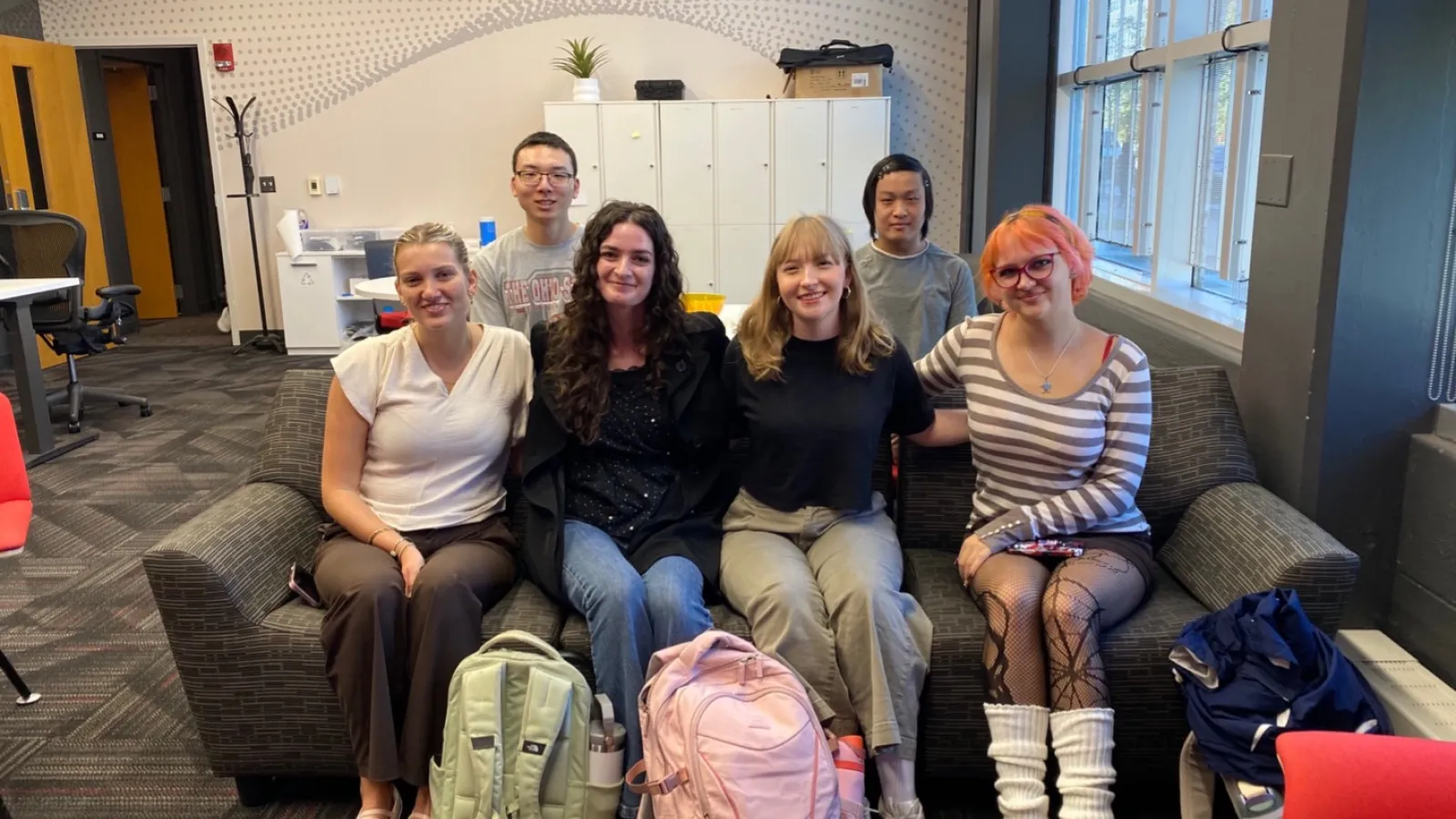
New Grant Puts OSU Undergrads at the Center of Chinese Theater Research
In spring 2026, the Department of East Asian Languages and Literatures was awarded an ASC Departmental Student Research Program Grant to support a cohort of 5 undergraduate students and 1 peer mentor to become paid project members of the “Chinese Theater Collaborative” (CTC), an internationally known digital resource center for traditional Chinese theater and modern media studies founded and co-edited by Prof. Patricia Sieber (Professor of Chinese Literature and Chair). The grant allows for students to have a mentored research experience as they make use of DH and AI tools, do research on modern media, and acquire general professional skills over the course of two semesters.
In fall 2026, the inaugural CTC cohort reflects the breadth of students interested in East Asia, technical tools, and career readiness. All members of the cohort are currently studying Chinese in DEALL, with enrollments ranging from first to fourth level. Some are humanities majors like Miriam Anderson, who is starting a bachelor’s degree in Chinese and hopes to combine language study with technology, research, and cultural exchange. Others are double majoring like Ashley Campbell, who is combining in Teaching English to Speakers of Other Languages (TESOL) with a major in Chinese or Sydney Osterman, an international studies major, who is going forward with the Translation and Interpretation Certificate and considering adding Chinese as a second major. Meanwhile, Hope Keller, an International Business major, is pairing that program with a minor in Chinese. Others lean into the sciences with a creative touch like James Liu, a Geographic Information Science Major, who also designs videogames. Jason Wang, an Applied Math/French double major, CTC contributor and longtime CTC project team member, will serve as the peer mentor.
All new CTC participants wanted to engage more deeply with Chinese culture for a variety of reasons. James Liu noted that he was drawn to the project because of its ties to his family heritage: “As a child of Chinese immigrants, I thought it would be prudent to learn more of their culture that I previously did not interact with.” Sydney Osterman also noted that how one family members sparked her interests in the arts: “My grandmother first introduced me to theater, and through her, I developed a lasting appreciation for the way theater can tell stories and connect people.” Ashley Campbell shared that she wanted to connect prior learning with practical applications: “After studying Mandarin for five years, including a study abroad stay in Kaohsiung (Taiwan), I wanted to find a way to take what I’ve learned in the classroom and apply it to something meaningful and hands-on." In a similar vein, Hope Keller emphasized how satisfying it can be to create something of one’s own: “Last semester, I took the C4404 Chinese Drama course with Prof. Sieber and built a CTC module exploring the musical elements of the Disney animation film Mulan (1998). It was the first time I got to do deep research and turn it into something of my own. Between that and a recent internship in Singapore, I’ve realized how much I want Chinese language and culture to be part of my future career.” Others also stressed the connection to their future career paths. Miriam Anderson said that “I hope the experience will prepare me for a career that involves cultural exchange and international engagement.”
This semester, everyone will familiarize themselves with AI, videoediting, and project management tools to assist CTC to transition to a new accessibility-friendly website. In the spring, everyone will have an opportunity to create a CTC module of their own and become a published author in their own right. As Hope Keller put it: “I’m excited to be part of this cohort and can’t wait to see what this year brings!”